
The Internet of Things (IoT) has evolved from simple hobbyist Wi-Fi sensors into mission-critical industrial automation backbones. In 2026, smart manufacturing plants, automated agricultural grids, remote solar telemetry farms, and smart logistics fleets rely on continuous, low-latency machine-to-machine (M2M) communication.
However, connecting physical hardware to cloud infrastructure introduces harsh engineering realities: intermittent cell connectivity, constrained device battery life, noisy sensor inputs, and strict security requirements against unauthorized firmware tampering.
1. The Industrial IoT Revolution in 2026
Modern businesses invest in IoT not to display static temperature gauges, but to achieve Predictive Maintenance, Asset Optimization, and Autonomous Operational Feedback Loops.
For example, monitoring vibration and temperature on industrial motors allows software to predict bearing failures 72 hours before catastrophic machine seizure—saving tens of thousands of dollars in factory downtime.
2. The 4-Tier IoT Architecture Stack
A scalable IoT deployment is structured across four distinct architectural tiers:
- Perception Tier (Sensors & Actuators): Hardware sensors measuring temperature, humidity, pressure, current draw, or GPS location connected via I2C, SPI, or RS485 Modbus protocols to microcontrollers (ESP32, STM32, Raspberry Pi Compute Module).
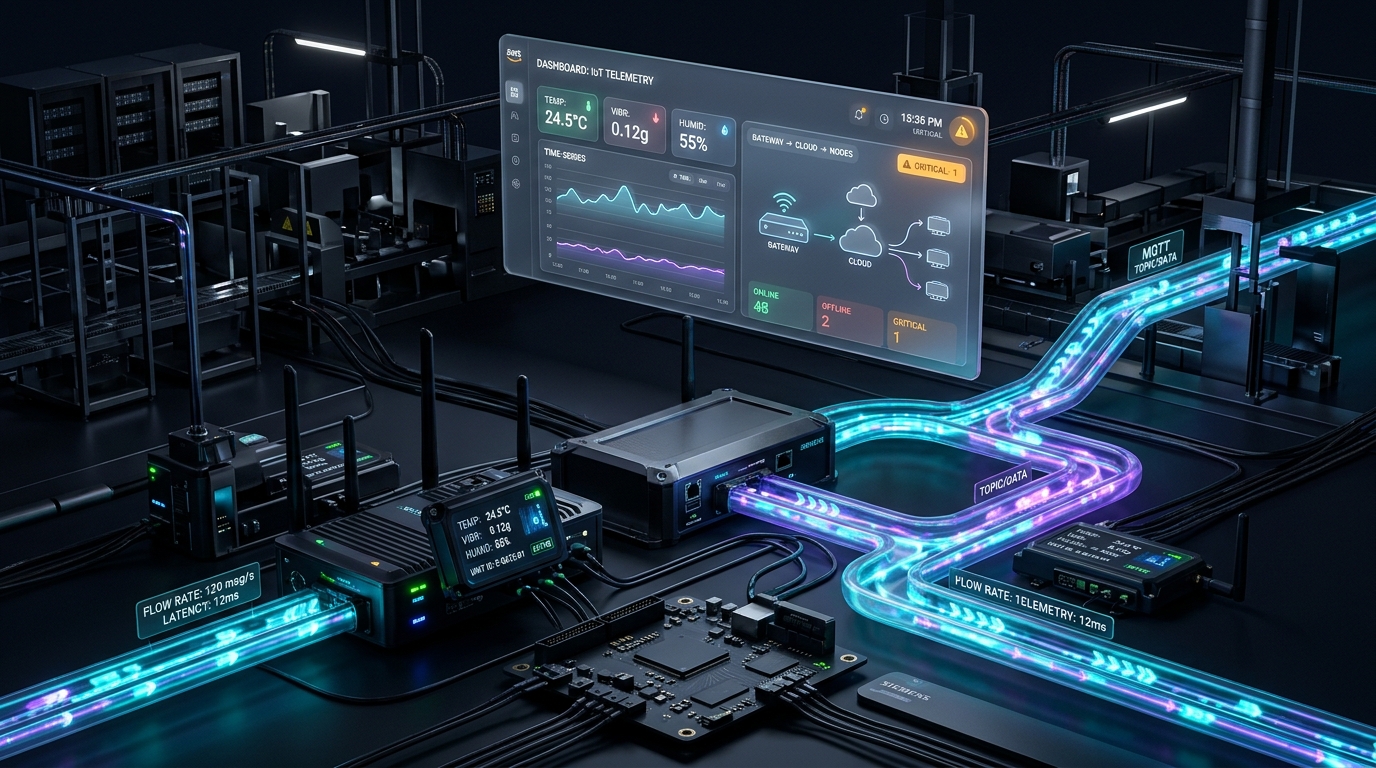
- Edge Gateway Tier: Local embedded computing hardware that aggregates telemetry from dozens of nearby sensors, sanitizes raw noise, performs local anomaly detection, and buffers data during network outages.
- Ingestion & Cloud Tier: High-throughput publish-subscribe message brokers (EMQX, Mosquitto, AWS IoT Core) processing millions of incoming messages per second into time-series databases (TimescaleDB, InfluxDB).
- Application & Visualization Tier: Responsive web portals and mobile companion apps displaying live real-time metrics, automated SMS/WhatsApp alerts, and fleet management controls.
3. Protocol Teardown: MQTT vs HTTP vs WebSockets
| Metric | MQTT (Message Queuing Telemetry Transport) | Standard HTTP/HTTPS REST | WebSockets |
|---|---|---|---|
| Header Overhead | Extremely Low (2 bytes minimum) | High (hundreds of bytes per request) | Low (2-10 bytes after handshake) |
| Communication Model | Pub/Sub with Broker | Request-Response (Pull) | Full-Duplex Persistent Socket |
| Quality of Service (QoS) | Built-in (QoS 0, QoS 1, QoS 2) | None (Manual application retries) | Application-level handling |
| Battery / Network Efficiency | Highest (designed for satellite/2G/4G) | Poor for periodic sensor heartbeats | Moderate to high |
| Best Use Case | Sensors transmitting to Cloud Gateways | Standard CRUD API endpoints | Cloud server streaming to Web Dashboards |
4. Edge Computing: Solving Bandwidth & Latency
Streaming 1,000 raw sensor samples per second per machine to the cloud is cost-prohibitive and fragile over rural cellular connections.
Edge Computing addresses this by deploying lightweight machine learning models and aggregation logic directly on local gateway hardware:
- The edge gateway computes 1-minute averages, min/max values, and standard deviations locally.
- Only summary telemetry is transmitted to the cloud under normal operating conditions.
- If sensor values exceed critical safety thresholds, high-resolution telemetry triggers immediately alongside local emergency machine shutdown relays.
5. Device Security & Over-The-Air (OTA) Updates
Deploying physical hardware in the field introduces unique attack vectors. Key hardware security essentials include:
- Hardware Root of Trust: Cryptographic secure elements (e.g., ATECC608A) storing private keys that cannot be extracted even if an attacker physically opens the device enclosure.
- Signed Firmware OTA: Every over-the-air firmware update must be digitally signed with private asymmetric keys. Devices verify the signature before flashing the image to prevent bricking or malicious hijacking.
- Dual-Partition Recovery: Maintain dual A/B memory partitions so the device can automatically roll back to the previously working firmware if an update fails to complete.
6. Designing High-Performance Telemetry Dashboards
Operators in industrial monitoring control rooms require instant situational awareness:
- Time-Series Visualization: Interactive zooming charts rendering months of continuous data using downsampling algorithms (like LTTB - Largest Triangle Three Buckets).
- Instant Incident Dispatching: Automated threshold escalation alerting engineers via WhatsApp, automated SMS, or webhook alarms when values breach acceptable ranges.
7. Conclusion
IoT and smart connected technology is transforming traditional industries into proactive, data-driven powerhouses. Building reliable hardware, cloud pipelines, and web interfaces requires an integrated engineering mindset.
Discover how Anshos Tech architects custom connected software platforms, or contact our team to discuss your smart technology initiative.