

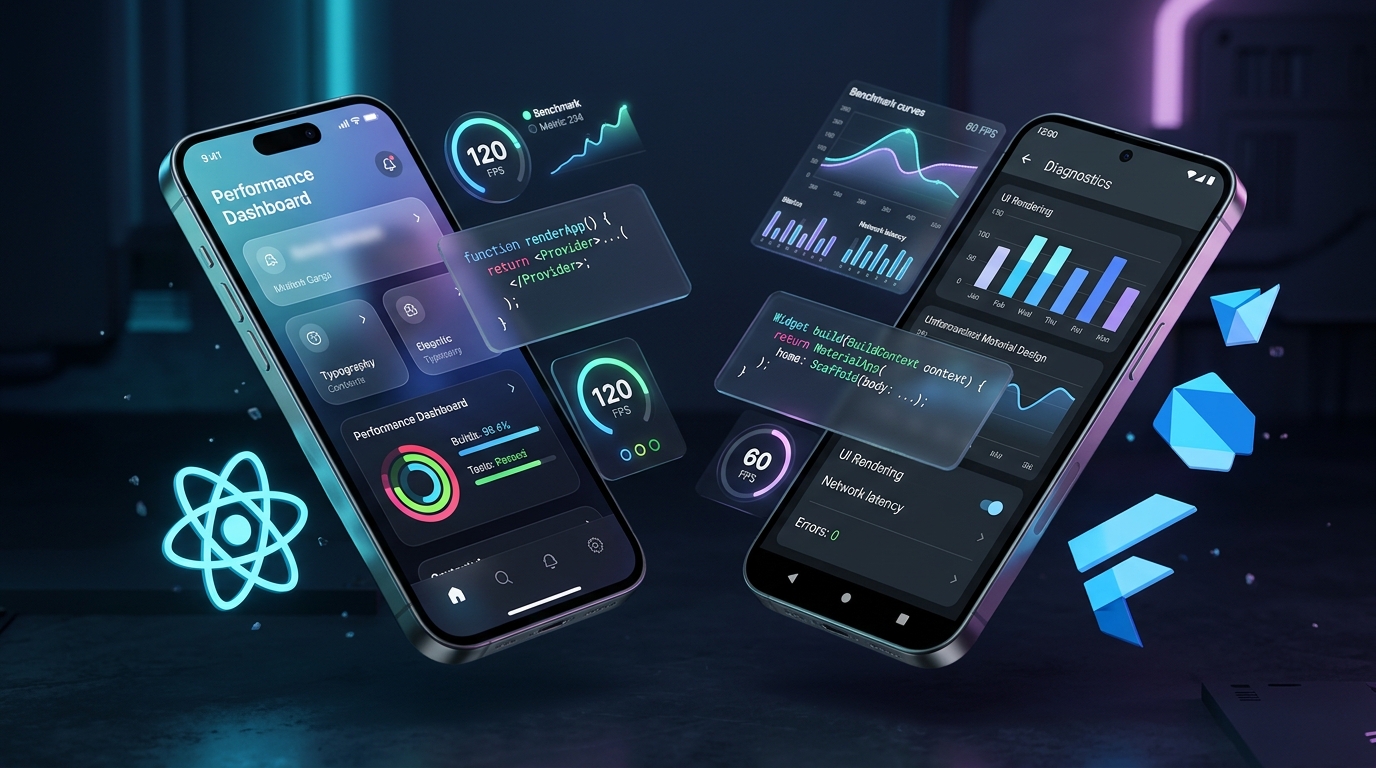
Building separate native iOS (Swift) and Android (Kotlin) codebases has become prohibitively expensive for 90% of companies. In 2026, cross-platform mobile frameworks deliver 60fps animations, native thread execution, and identical UI fidelity while cutting development and maintenance costs in half.
The two undisputed titans in this space remain React Native (backed by Meta) and Flutter (backed by Google). But with React Native’s New Architecture (Fabric + TurboModules) now battle-tested and Flutter’s Impeller rendering engine fully mature, which one makes the best engineering and commercial sense for your next mobile product?
1. The 2026 Cross-Platform Landscape
Both ecosystems have progressed far beyond early hybrid technologies like Cordova or PhoneGap. Today, both compile to native machine instructions or interface directly with native OS graphics subsystems.
However, their fundamental philosophies diverge completely:
- React Native: Embraces the native host operating system. It renders authentic native OEM UI widgets (e.g.,
UICollectionViewon iOS andRecyclerViewon Android) using a shared TypeScript/JavaScript codebase. - Flutter: Bypasses native OEM components entirely. It acts like a high-performance game engine, painting every pixel, button, and navigation transition directly onto an OS canvas via Google’s Impeller graphics engine.
2. Architectural Comparison: Bridge vs Canvas
| Feature | React Native (New Architecture) | Flutter (3.x + Impeller) |
|---|---|---|
| Primary Language | TypeScript / JavaScript (ES2026) | Dart |
| UI Rendering | Real Native OS Controls (Fabric) | Custom Painted Canvas (Impeller) |
| JS Bridge Overhead | Zero (Direct C++ JSI / TurboModules) | N/A (Ahead-Of-Time Native Machine Code) |
| App Bundle Size | Smaller baseline (~8MB - 14MB) | Slightly larger baseline (~12MB - 22MB) |
| Code Sharing with Web | Very High (React Native for Web, shared hooks & state) | Moderate (Flutter Web requires separate UI tuning) |
3. Real-World Performance: Hermes vs Impeller
In historical benchmarks, Flutter was praised for silky 60fps animations while React Native suffered occasional frame drops during heavy JSON bridge serialization.
In 2026, React Native’s Hermes Bytecode Engine and JavaScript Interface (JSI) eliminated the legacy JSON bridge completely. C++ native modules communicate synchronously with the JavaScript runtime in microsecond execution windows.
Meanwhile, Flutter’s Impeller engine eliminated runtime shader compilation stutter (jank) on iOS and Android by pre-compiling shaders during build time. For 98% of business use cases—including e-commerce, banking, logistics, and social feeds—both frameworks deliver imperceptibly smooth 60fps performance.
4. Talent Pool & Developer Velocity
This is where commercial realities heavily favor React Native. Over 68% of global developers are already proficient in JavaScript and TypeScript. A team building a React web application can seamlessly cross-train or share code with their React Native mobile application.
Dart, while clean and easy to learn, remains largely confined to the Flutter ecosystem. Recruiting senior Dart engineers in India and North America commands higher recruitment premiums and longer hiring cycles.
5. Native Device Integration & Ecosystem
When your mobile app requires complex OS capabilities—such as background location tracking for logistics, biometric FaceID/TouchID authentication for FinTech, Bluetooth LE for IoT hardware, or camera barcode scanners—the ecosystem matters:
- Expo & React Native: Expo has matured into a production powerhouse. With Config Plugins and Prebuild, developers can install native iOS and Android SDKs without ever maintaining brittle manual Gradle or CocoaPods configurations.
- Flutter Plugins: Google and the community maintain high-quality plugins, but third-party SDK vendors (like niche payment gateways or enterprise hardware) frequently release their official native SDKs for React Native months before Flutter.
6. Decision Framework: When to Choose Which
Choose React Native if:
- You already have a web development team proficient in React and TypeScript.
- Your app needs to look and feel 100% native according to Apple Human Interface Guidelines and Material Design.
- You plan to share business logic, API models, and authentication code between your web portal and mobile app.
Choose Flutter if:
- Your brand requires a highly customized, branded UI that must look identically identical down to the sub-pixel on both iOS and Android.
- You are building a graphics-heavy product, 2D game, or visual design canvas.
7. Conclusion
Both frameworks are world-class engineering solutions in 2026. For businesses focused on speed-to-market, talent availability, and unified web/mobile architectures, React Native remains our top recommendation.
Have a mobile app concept in mind? Check out our mobile application engineering services or discuss your requirements directly with our senior architects.